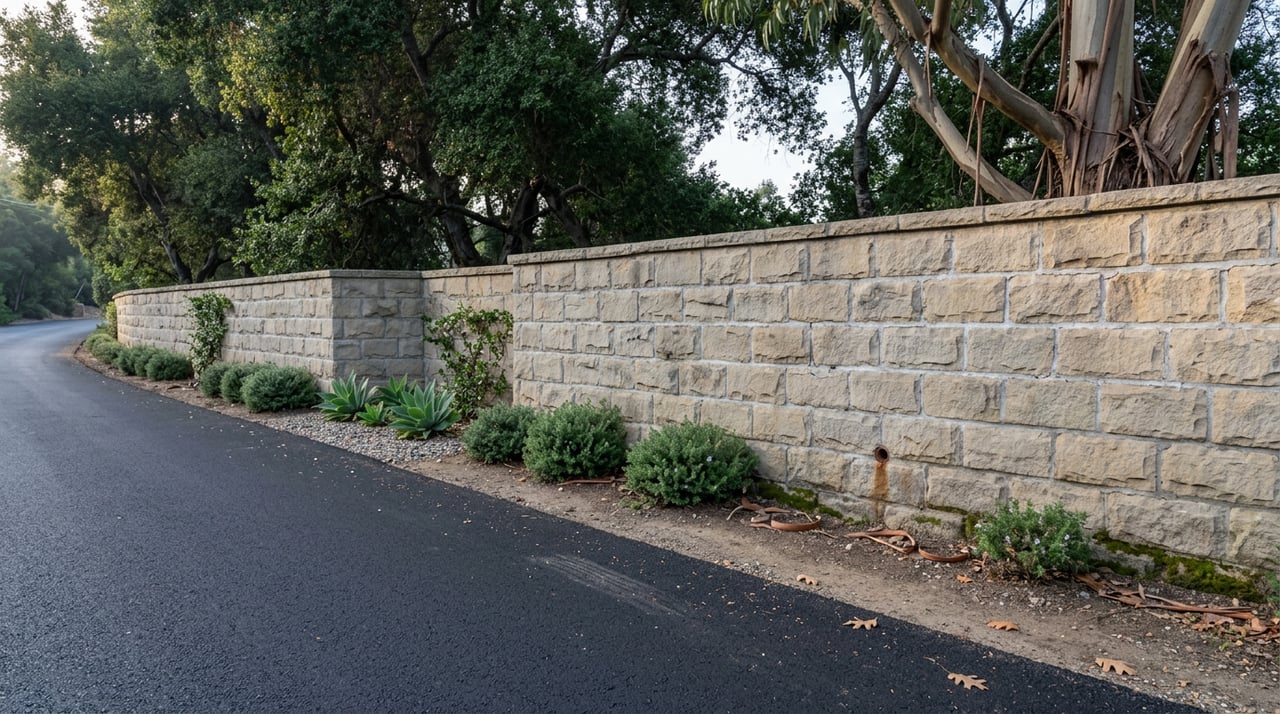
Walk Eucalyptus Hill Road this month and the first thing you notice is the smell. Fresh asphalt, laid down in sections between July 28 and August 4 by the City of Santa Barbara's Streets Operations Division. The work started at the Salinas Street roundabout and moved block by block up Alameda Padre Serra before finishing on the upper stretch of Eucalyptus Hill Road itself, the crews posting no-parking signs and closing driveway access for stretches between 7 a.m. and 5 p.m. each day.
It is a small thing, a road resurfacing. But it is also one of the few times in recent memory that the city has done something to this neighborhood rather than the neighborhood doing it for itself.
A Few Weeks of City Attention
The paving schedule ran in tight, dated phases: the roundabout on July 28, the 300 to 600 blocks of Alameda Padre Serra on July 29 and 30, then the lower blocks and the 1800 block of Eucalyptus Hill Road on August 3 and 4. Anyone who lives along that corridor spent a week rerouting around orange cones and timing errands around the no-parking windows.
What's notable is how rarely this kind of city-led project happens up here. Eucalyptus Hill's roads wind and narrow in ways that make them feel private even where they aren't, and most of the visible upkeep on the hill, from trail maintenance to fire mitigation to the stone marker at its own front door, has come from residents organizing and paying for it themselves through the Eucalyptus Hill Improvement Association. The repaving is the exception. Almost everything else on this list is not.
The Trail the City Didn't Build
Start with the Alston Road Walking Trail. It exists because the EHIA went out and acquired the permits, installed it, and now maintains it, not because a parks department decided the hill needed one. The same association pushed the city's Streets Operations and Infrastructure Management Division to narrow the fog lines on Alston Road to slow speeding, and in an earlier project got an asphalt berm and Botts' dots installed at Barker Pass to stop drivers from running the stop sign there. In both cases the city executed the work, but the neighborhood identified the problem and asked for it.
The entrance stone at the Salinas Street roundabout tells the same story in miniature. It was not a city beautification project. The stone, the engraving, and the installation were donated outright by three local businesses: DaRos Masonry, Santa Barbara Stone, and Santa Barbara Monumental. The city's role was limited to helping the association secure a grant to cover the permits, with Derrick Bailey at the City of Santa Barbara credited for that assist. Everything else, from the idea to the execution, was neighbors deciding the hill needed a marker and then building one.
A quick tally of what residents assembled on their own over the years:
- The Alston Road Walking Trail, permitted and maintained by the EHIA
- The entrance stone at the Salinas roundabout, materials and labor donated by three local firms
- Narrowed fog lines and a traffic berm on Barker Pass, initiated by the association and executed with city cooperation
- A membership-funded vegetation management program that brings grazing animals into the canyons each spring
That last one deserves its own explanation, because it is the strangest and most consistent example of the pattern.
Goats Again This Spring
Every spring since 2021, the EHIA has hired grazing animals to clear brush in the canyons that lace the hill, land that slopes down toward the Montecito Country Club behind streets including Alston Road, Rametto Road, Cima Linda Lane, Owen Road, and Eucalyptus Hill Road. The contractor changes almost every year. Cuyama Lamb handled the first round in 2021. Ventura Brush Goats took over in 2022 and returned again at the end of April 2024, when the goats cleared the upper canyon off Eucalyptus Hill Road and a follow-up crew from Home & Range Vegetation Management hauled out the dead wood left behind. The association's most recent posted update names Golden State Goats for its largest canyon, between Eucalyptus Hill Road and Cima Linda Lane, working from late May through the first week of June.
None of it is funded by a city budget line. It runs on donations from the homeowners whose properties border the canyons, solicited block by block. Loy Beardsmore, the association's board president, described the goal as giving firefighters "a real opportunity to control future fires" in terrain the city's own Community Wildfire Protection Plan had already flagged as a concern. The animals graze a fenced two to three acre section at a time, protected from predators by guard dogs, before the fence line moves to the next stretch of canyon.
It is an unusual amount of coordination for a residential street to organize on its own, and it happens quietly enough that most visitors driving through would never know it was happening at all.
A Park Named for a Marriage
Hale Park sits at the low end of this same self-organizing ethic, though its origin is older and stranger. The 13-acre parcel was once part of Solana, the estate built by Frederick Forest Peabody, the Arrow Shirt Company founder who imported the eucalyptus trees that gave the neighborhood its name. After Peabody's death, his widow remarried a man named Hale, and the couple donated the land to the City of Santa Barbara, which formally established it as a park in 1954.
What you get today is a banana-shaped, tree-shaded loop that covers about 0.7 miles with roughly 88 feet of elevation gain, one of the only spots in the region where dogs are allowed off leash. There are no restrooms and no water fountains. Access is mostly from a dirt pullout on Camino Viejo, and the only real amenity is a doggie bag dispenser near the entrance. It functions less like a maintained municipal park and more like a piece of shared backyard that the neighborhood has quietly agreed to use as one.
The Walls Knapp's Stonemasons Built
The instinct to build things by hand here goes back further than the current improvement association. In 1911, George Owen Knapp, one of the founders of Union Carbide, bought a 70-acre parcel on the hill known as Arcady, eventually expanding it with an additional 50 acres and gardens that displayed nearly 400 plant varieties. During the Depression, Knapp hired local Italian stonemasons to build sandstone walls around the property, and many of those walls are still standing along Alston Road today.
A few hundred yards away, Cornelius Billings, another Union Carbide founder, built stables below his own property near Old Coast Highway and Salinas Street for a world champion trotter named Lou Dillon. The street that runs through that stretch still carries the horse's name. None of this was public infrastructure either. It was private wealth building private structures that outlasted the people who commissioned them, which is not so different from what a homeowners' association funding a walking trail and a herd of goats is doing now, just at a very different scale and with a very different budget.
What the Hill Actually Asks of the City
Put it together and the picture that emerges is not the generic one, quiet streets, big views, expensive homes. It's narrower than that. Eucalyptus Hill is a place where the city's role has historically been limited to roads and permits, while almost everything that makes the hill function day to day, the trail, the entrance marker, the fire mitigation, even the park's original 13 acres, came from private hands, whether that's a 1930s industrialist's stonemasons or a modern volunteer board collecting donations block by block.
The repaving that just wrapped up is a reminder of how rare it is for the city to be the one doing the building here. Most weeks, that job still belongs to the people who live on the hill.
I currently serve on the Eucalyptus Hill Improvement Association's board, which is part of why these small, unglamorous projects matter to me. If you're curious about the hill, its history, or what it actually takes to keep a neighborhood like this running, reach out to Maureen McDermut & Associates to schedule a private consultation.